
This month I am fulfilling a promise that I made to our webmaster a long time ago, when I told her that I could probably produce images showing inn signs on three buildings in Luccombe. I have been searching for one of these images and have only recently found it, and although it is a copy of a copy, it is nevertheless quite acceptable. Unfortunately the other images are poor quality screenshots.
The image in question is the first one, which is of a drawing from 1849 by W.W. Wheatley, showing the upper part of Stoney Street with The Cottage in the distance. There is a huge amount of artistic licence, but at that time, there was a barn occupying what is now the entrance to 2 East View. To quote Isabel Richardson’s findings: – “A barn is recorded butting on to the bottom end of “The Cottage” on the 1842 Luccombe Tithe map. The property, unlike all the rest of the buildings on the northwest side of Stoney Street, belonged to Sir Thomas Dyke Acland. By the time the 1889 O.S. first edition 1:2500 map was surveyed, the barn had gone. The entrance to the two council houses now cuts through the position the barn once held.”
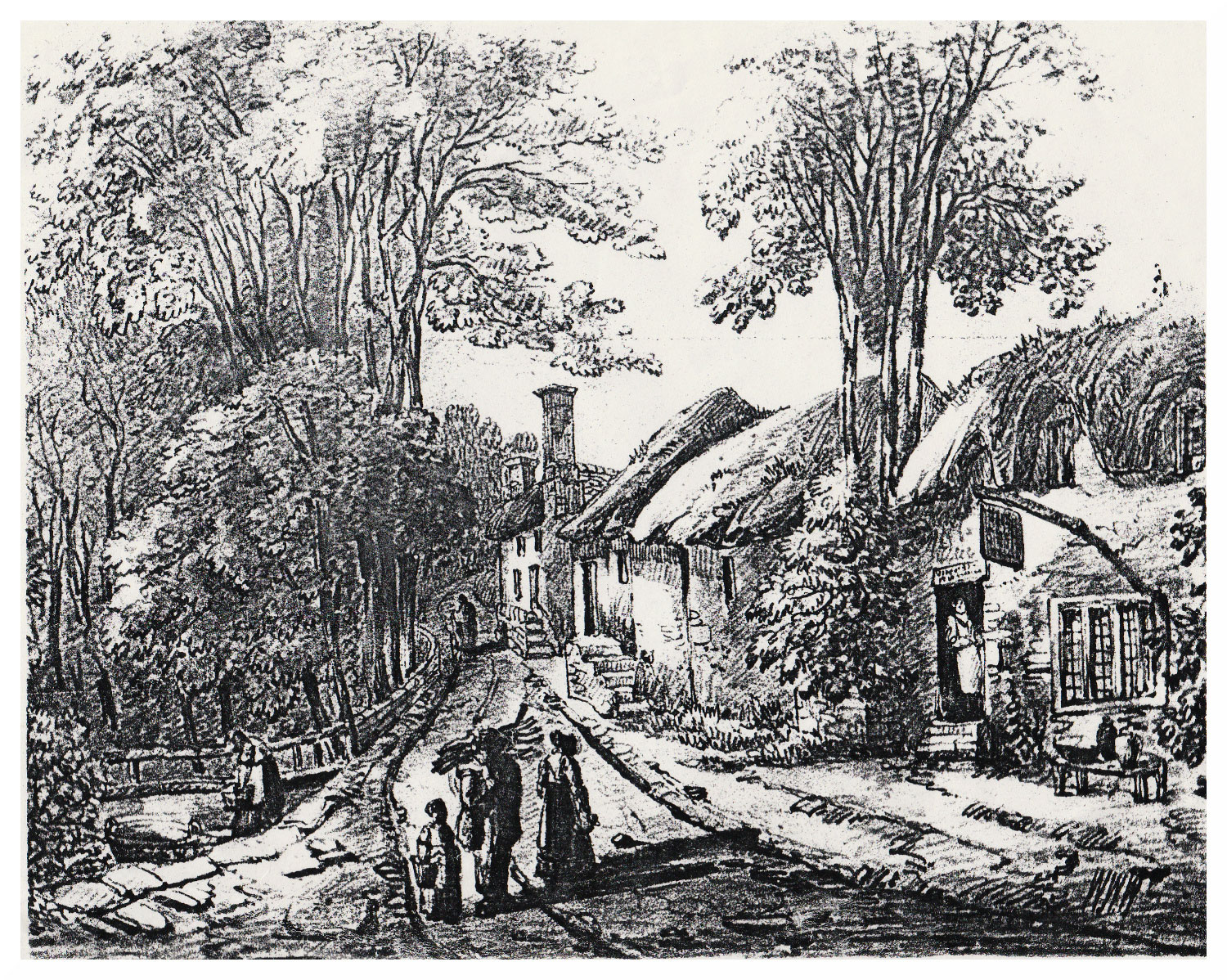
Indeed, when improvements to the entrance of 2 East View were made around forty years ago, the foundations were exposed and photographed by the owners.
The dwelling on the right with the inn sign, table in the forecourt bearing assorted drinking vessels and ‘innkeeper’ in the doorway must be somewhere in the Rose Cottage/Porch Cottage area. There used to be a belief that there was something like a “cider house” somewhere in the village – despite the lack of any records. Until “Wells Wood Leap” and “Aydon” were built, there used to be hops growing in the hedge between Culver Close and Coombe Cottage as well as on the bank at the end of School House garden. These could well have been used in the local brewing of beer.
Pictures 2 and 3 are taken from the BBC TV series “The Invisible Man”. Many of the location scenes were filmed in October 1983, “in the vicinity of Taunton in Somerset” (according to the accompanying viewing notes). Luccombe was transformed into the 1890’s village of Iping, and Oakapple Cottage in Stoney Street became the “Coach and Horses”. The wooden sign over the entrance stayed in the village when the filming ended and it made a quite a conversation piece in several “Old Luccombe” exhibitions during the following years. Because of its rustic construction, it looked like a genuine artefact!

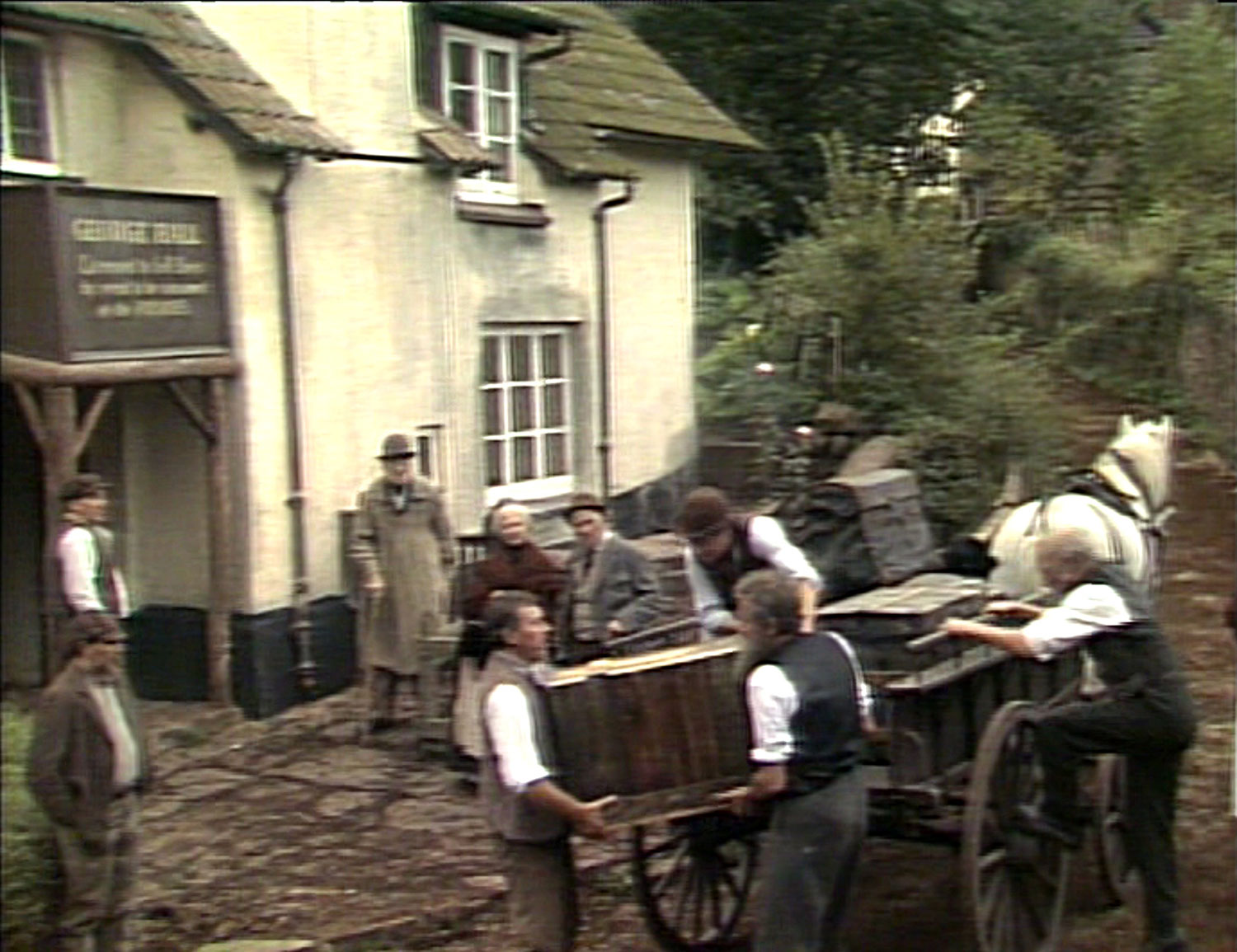
The series of six half-hour episodes was scheduled for transmission early in 1984 occupying the Sunday afternoon drama slot, but when the programmes were previewed, it was judged that some scenes – especially one showing the invisible Griffin chasing a visible Kemp with a visible axe – were too frightening, and the Invisible Man was finally allocated the 8pm slot on Tuesday evenings, starting in early September 1984.
BBC Audience Research found that the audience had averaged 7.4 million, with an audience appreciation index of 49, which was considerably lower than the average for similar series which was running at 73. “Most of those reporting were unimpressed by this six part dramatisation” …..”The series was often considered slow and boring”…..”A third of the sample said they had stopped watching after the first couple of episodes, the overwhelming reason being boredom”. The series was not repeated in this country, although it sold well overseas, attracting an audience of 64 million in the Soviet Union!
The final 2 images are screenshots from HTV’s “Exmoor Village” series, filmed in the village in the summer of 1987 and first televised in the autumn of 1988.
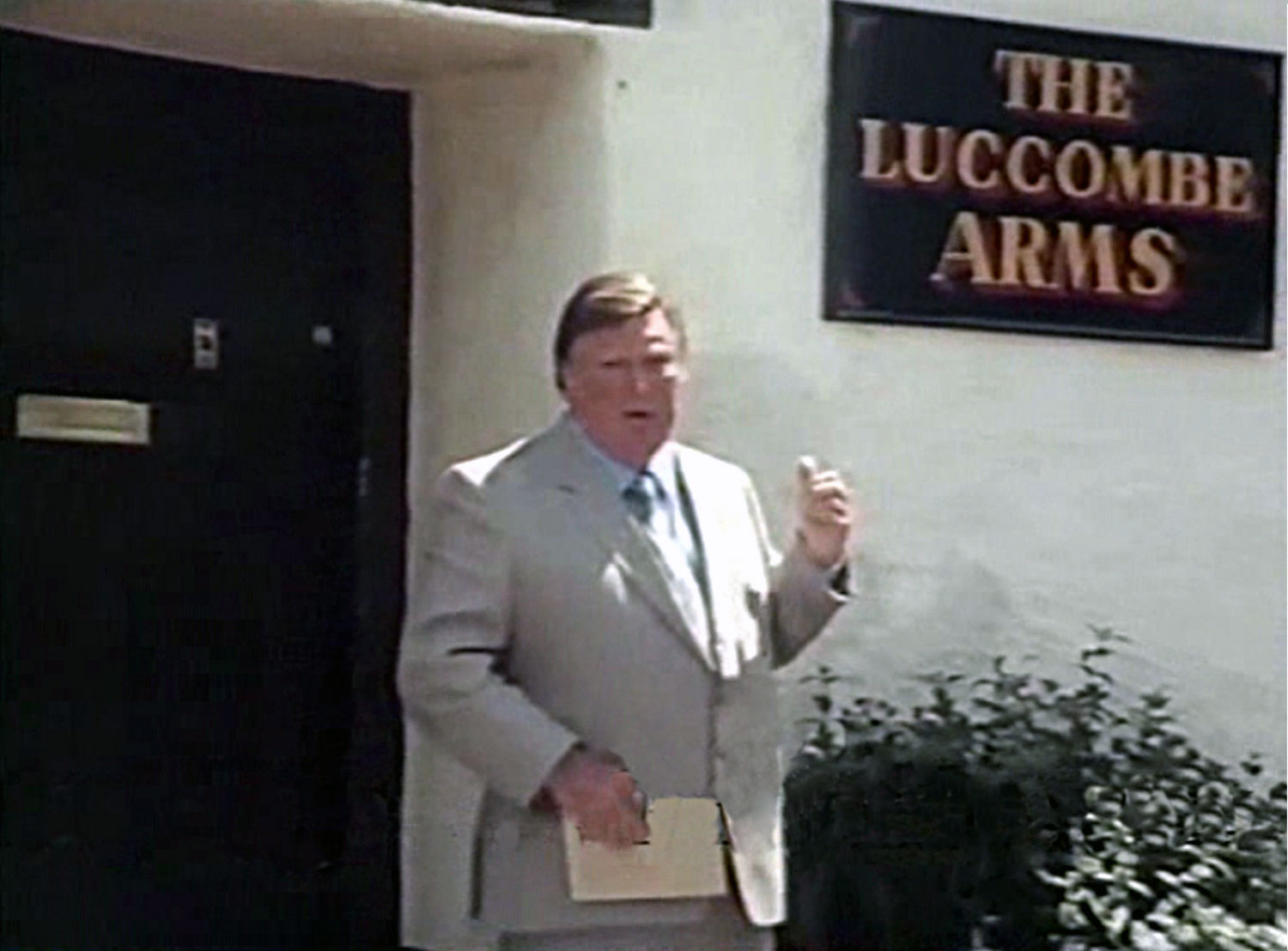

In this scene which forms part of the title sequence of the fourth and final episode- “Luccombe Future”, the late Dan Farson is filmed standing on the front steps of Church View explaining what life in the village might be like in years to come. As with “The Invisible Man”, there were scheduling problems. The first episode was due to be shown on Friday 9th September 1988, but at short notice was replaced with a special edition of “The South Bank Show” discussing Martin Scorsese’s newly released controversial film “The Last Temptation of Christ”, meaning that part one of “Exmoor Village” was delayed until Friday 16th September.
Finally this month, I would like to give a mention to a new book which has just come out. Written by Jeff Cox, it is primarily about the involvement of those from the parishes of Porlock, Luccombe and Selworthy who served during the Second World War. Published in conjunction with Dovery Manor Museum, it contains detailed tributes to all of those in the three parishes who lost their lives, together with a wealth of other local information besides. It is a well-illustrated 120-page glossy hardback called “Those Who Served” and is only available direct from Jeff, who will be pleased to supply more details if asked. His contact information is on the Dovery Manor Museum website
Check out all of our previous pictures of the month and read more about Luccombe’s history
Leave A Comment