
I have discovered so much recently about two descendants of a family that farmed at Holt Ball in the early twentieth century, that this topic will take three “Pictures of the Month” to do it justice. This first part covers the general history and the occupiers of these farmsteads, the second describes the Crick family at Holt Ball and the final part uncovers the exploits and careers of two eminent Crick sons.
In researching these chapters, I am indebted to Mr Peter Ashford and his son, Philip, for photographs and historical information and to the late Mr Fred Partridge for his correspondence and informative press cuttings, which have until recently been hiding forgotten in my ‘files’ since the days of the “Old Luccombe” exhibitions and which, after further investigation, resulted in the third part of this collection.
I can find no specific reference to Holt Ball in Chadwyck-Healey’s “History of Part of West Somerset”. He did however discover that during a dispute between members of the Arundell family who were Lords of the Manor of Luccombe for generations:
”On Thursday next before the feast of St Nicholas 1558, Robert Arundell entered upon the manor of East Luccombe at a place called Holt Ridge, and claimed it on behalf of his co-trustees and himself”.
There is a reference to fields known as Holt Ball in a 1598 survey of the Manor of Luccombe, and in a book of churchwarden’s accounts there is written a long list of parishioners, including inhabitants of Holt Ball, who contributed towards repairs in 1636 as described thus:
“Luckham Churchyard wall was made new in ye year one thousand six hundred thirty and six and every part containing three feet and five inches beginning at the Persons (Parson’s?) Meadow.”
It is assumed that each person or dwelling that was listed paid the sum required to re-build three feet five inches of the wall.
Chadwyck-Healey also refers to the former house at Holt by writing:
“A little further on the road (i.e. from Blackford towards Gillams Cottages) in the direction of Luccombe, there stood until shortly before the fire at Blackford (in 1875), another substantial and ancient house. It was considered unnecessary, and was pulled down in the latter part of 1874 and beginning of 1875. Had it stood a few months longer, the calamity at Blackford would probably have saved the old house at Holt. In the still more ancient and ruder house at Holt, there lived in the time of Edward 1st, Margery of Holt, who established against Hugh de Luccombe her claim to have estovers, wood, that is, for the repair of her house, from Hugh’s woods at Luccombe and Holt……”
All that now remains of Holt is a bank barn with date stone ‘JH 1861’ on it, and a small building the other side of the road which is an ash house. The site was first mentioned in the 1327 Lay Subsidy, held by John de Holte. In circa 1270, John of Holt is listed as one of the Woodwards, ie a forester employed to look after the trees and game in a forest, while Walter Cumin of Holte is listed in the pleas of vert (a legal action regarding forest vegetation) of 1270. Walls and platforms of the gardens and buildings at Holt are still visible beyond the existing barn. Abraham Clarke was living at Holt in 1841, and in the 1851 census was described as “Yeoman of 90 acres and employer of 3 labourers”. By 1861, Holt was uninhabited.

Almost all that is left of the farmstead at Holt – the bank barn dated 1861. By the time this was built, Holt was already unoccupied and the terrace marking its location is to the right of this picture, by the row of conifers. The ash house is behind the photographer, on the other side of the lane.
Moving back to Holt Ball, the Ashford research found evidence of Lord John Arundel granting a lease to John Gregory in 1685 and in 1736 to Joan Blackford (related to the Blackfords of Holt). In 1742 a new lease was taken out by Joan, Mary & Ann Blackford (daughters of the previous Joan) and in 1756, Samuel Gregory married Ann Blackford and would have taken up residence at Holt Ball., Lord Arundell granting him a lease in reversion in 1766. In 1781, William Gregory (son of Samuel and Ann) was paying land tax so must have been the occupier of Holt Ball even though his mother did not die until 1811.
John Ridler took over Holt Ball in 1816, and from then, Holt Ball expanded as a farm, while Holt gradually declined. William Ridler, John’s son lived and worked on the farm until at least 1851, the 1841 census listed John as the head of the household, with his wife Mary, son William and daughter Mary and in 1851 he was “Farmer of 140 acres employing 4 labourers” The 1861 census has William Pavey as the occupier faming 130 acres and employing 3 men and a boy. William Pavey died aged 41 in 1879, and in the 1881 census, his widow Amelia was still living there, with the farm being run by a bailiff, James Priscott. At the same time, William Ridler was living nearby, maybe in one of the Gillams Cottages and was described as a “Farmer of 18 acres employing 1 man.”

William Ridler, John Ridler’s son, who was at Holt Ball until at least 1851, photographed on his 85th birthday, January 20th 1899 at his home in Alcombe.
Later in 1881, David Knight and his son, Robert took the tenancy. In addition to being farmers, they were both cattle dealers and David also farmed at Troytes, Tivington where he was living in 1891, with Robert and his young family in residence at Holt Ball.
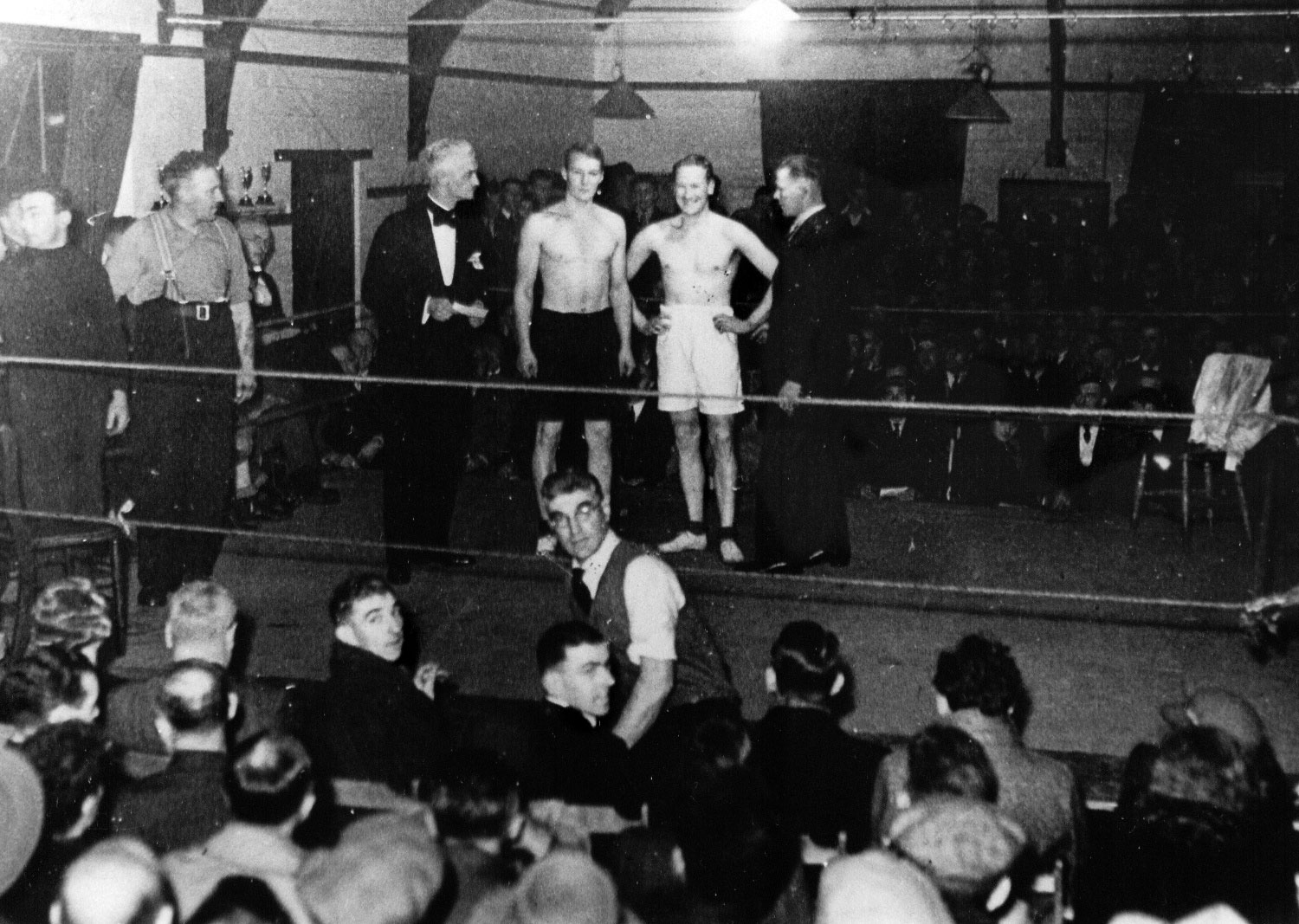
Boxing match between Norman Kennelly of Holt Ball, against George Catford of Minehead, which took place in the Moorland Hall, Wheddon Cross. The man in evening dress is Captain Wilton at one time Hon Sec to the Devon and Somerset Staghounds. Norman lost the fight on points but the rematch took place at the Regal in Minehead which he won by a knockout
From 1885 until 1923, Holt Ball was occupied by the Crick family, and this period will be covered in the next “Picture of the Month”. In 1925, Mr H. J. Thomas, the son of the farmer at Horner took over. From 1924 Robert Williams was the tenant farmer, until he moved a little further along the lane to Huntscott Farm in 1936, being succeeded by Mr Stevenson who stayed until 1939. Norman Kennelly then took the tenancy, followed by Peter Ashford in 1954. Norman Kennelly was something of an amateur boxer, appearing in the ring at contests staged in Minehead’s Regal Ballroom. I can remember walking up to the farm with my mother to attend the dispersal sale when Norman Kennelly sold up.
Check out all of our previous pictures of the month and read more about Luccombe’s history
Leave A Comment